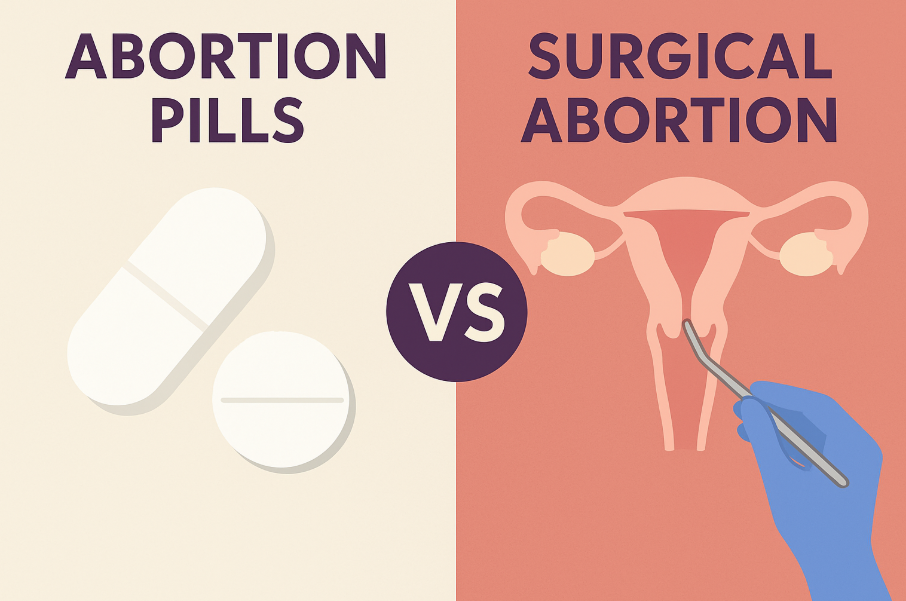
When facing an unplanned pregnancy, making a safe and informed decision is essential. Understanding your options — especially when comparing abortion pills vs surgical abortion — helps you take control of your body and your future. These two methods are the most common and medically approved ways to end a pregnancy safely and effectively.
While both are considered safe, the right choice depends on factors such as how far along you are, your overall health, access to care, and your comfort level. In this guide, we’ll explain the key differences, advantages, safety measures, and recovery process for both abortion pills and surgical abortion — so you can make a decision that’s right for you, with confidence and care.

What Are Abortion Pills (Medical Abortion)
Abortion pills, also known as medical abortion, use medication to end an early pregnancy. This method is approved for pregnancies up to 10–12 weeks, depending on local guidelines and healthcare provider recommendations.
It typically involves two medications:
Mifepristone – blocks the pregnancy hormone (progesterone), causing the uterine lining to thin.
Misoprostol – causes the uterus to contract and expel the pregnancy tissue.
This process usually takes 24–48 hours after taking the second pill, and the experience is often similar to a heavy menstrual period.
What Is Surgical Abortion?
Surgical abortion is a clinical procedure performed by a healthcare professional to remove the pregnancy from the uterus. It’s usually recommended for pregnancies beyond 10 weeks or when medical abortion isn’t suitable.
There are two main types:
Manual Vacuum Aspiration (MVA): for early pregnancies (up to 12–14 weeks).
Dilation and Curettage (D&C) or Dilation and Evacuation (D&E): for later stages (beyond 14 weeks).
The procedure is typically quick — lasting 5 to 15 minutes — and is performed under local or mild sedation anesthesia.

Abortion Pills vs Surgical Abortion: The Key Differences
Abortion Pills vs Surgical Abortion — Quick Comparison
Helpful comparison of methods, timing, privacy, recovery and follow-up.
| Aspect | Abortion Pills | Surgical Abortion |
|---|---|---|
| Method | Uses medication (Mifepristone + Misoprostol) | A minor medical procedure performed by a doctor |
| Timing | Up to 10–12 weeks of pregnancy | Usually after 6 weeks; recommended up to 20 weeks depending on local laws |
| Privacy | Can be done at home (with medical guidance) | Performed in a clinic or hospital |
| Duration | Takes 1–3 days for completion | Procedure itself takes about 10–15 minutes |
| Bleeding | Heavy bleeding for a few hours, then light spotting | Minimal bleeding post-procedure |
| Pain | Cramping similar to period pain | Mild discomfort, usually less intense |
| Effectiveness | 95–98% | ~99% |
| Follow-up | Often required to confirm completion (test or provider check) | Usually minimal follow-up needed |
Note: This table is for informational purposes only. Always consult a licensed healthcare professional for personalized medical advice.
👉 [Get Free Doctor Consultation – Click Here to Submit Your Form]

Advantages of Abortion Pills (Medical Abortion)
- 1. Privacy and comfort: You can take the abortion pills in your own home, surrounded by comfort and privacy.
- 2. Non-invasive: No instruments or surgery are required
- 3. Feels more natural: Many women describe it as similar to a miscarriage.
- 4. Accessible: Can be prescribed through telemedicine in many regions, offering discreet access.
- 5. Safe and effective: When taken correctly under medical supervision, it’s over 95% effective.
Advantages of Surgical Abortion
- 1. Quick and complete: The entire process takes only a few minutes.
- 2. Less bleeding: Compared to pills, post-procedure bleeding is lighter and shorter.
- 3. Can be done later in pregnancy: Safe up to 20–24 weeks depending on local laws.
- 4. Supervised care: Performed by trained doctors, ensuring safety and precision.
- 5.Immediate confirmation: The pregnancy is removed completely, eliminating uncertainty.

Possible Side Effects of Each Method
Both methods are safe when supervised by licensed healthcare professionals. Complications are rare and easily managed with proper aftercare.
Surgical Abortion
- Mild cramps or soreness after procedure
- Light bleeding for a few days
- Rare: infection or injury (extremely uncommon in safe medical settings)
Abortion Pills
- Cramping and bleeding for several hours
- Nausea, vomiting, or mild fever
- Fatigue and emotional sensitivity
- Rare: incomplete abortion (requires follow-up treatment)
👉 [Book Your Free Doctor Consultation – Click to Submit Your Form]
How to Decide: Which Is Right for You?
Choosing between abortion pills and surgical abortion depends on your personal, medical, and emotional needs. Here’s a simple guide to help:
Choose Abortion Pills if:
- You are under 10–12 weeks pregnant.
- You prefer privacy and the comfort of home.
- You are comfortable with a process that takes a few days.
- You have medical support available online or nearby.

Choose Surgical Abortion if:
- You are over 12 weeks pregnant.
- You want the procedure to be quick and fully supervised.
- You prefer a definitive, same-day result.
- You have a qualified clinic or doctor you trust.
👉 [Book Your Free Doctor Consultation – Click to Submit Your Form]
Safety and Medical Guidance
No matter which option you choose, medical supervision is essential. Self-managing without guidance can be risky. Always:
Confirm your pregnancy duration through an ultrasound or test.
Consult a qualified provider or telehealth service before taking any pills.
Avoid unverified online stores — counterfeit or unsafe pills can cause complications.
Monitor your symptoms — if you experience heavy bleeding, severe pain, or fever, seek help immediately.
If privacy is your concern, many licensed online services now provide confidential women’s consultations online, where doctors can guide you safely and discreetly.
Emotional Well-being After Abortion
Abortion — whether medical or surgical — can bring mixed emotions: relief, sadness, or anxiety. All of these are normal.
Take time to rest, eat well, and reach out for emotional support if needed.
You can talk to:
- Women’s health counselors
- Support groups
- Online mental wellness professionals
Remember — choosing abortion doesn’t define your worth or your future. It’s a personal decision made for your body, your health, and your life.
👉 [Click Here to Submit Your Consultation Form Now]

Aftercare Tips
Both methods are safe when supervised by licensed healthcare professionals. Complications are rare and easily managed with proper aftercare.
After Abortion Pills:
- Expect bleeding for up to 2 weeks.
- Avoid inserting anything into the vagina (tampons, sex) for at least 7–10 days.
- Take prescribed pain relief if needed.
- Follow up with your provider after 7–14 days to confirm completion.
After Surgical Abortion:
Rest for at least 24 hours.
Avoid heavy physical activity for a few days.
Take all antibiotics or medications prescribed.
Contact your clinic if you have fever, foul-smelling discharge, or heavy bleeding.
👉 [Book Your Free Doctor Consultation – Click to Submit Your Form]
Myths vs Facts
| Myth | Fact |
|---|---|
| Abortion causes infertility | False: When done safely, it doesn’t affect future fertility. |
| Surgical abortion is dangerous | False: Modern surgical abortion is among the safest medical procedures. |
| Medical abortion is painful and risky | False: It’s safe, effective, and manageable with medical guidance. |
| You can’t get abortion pills online | False: Many licensed telemedicine providers offer safe, discreet access. |
Always consult a certified healthcare provider for accurate medical guidance.
Global Perspective: Accessibility and Awareness
Access to safe abortion varies worldwide. In many regions, misinformation or stigma prevents women from seeking help.
However, awareness and online medical consultations have made it easier to get private, doctor-approved guidance without fear or judgment.
If you’re seeking a private women’s consultation online, many reputable platforms provide:
Confidential medical advice
Safe abortion pill prescriptions
Recovery guidance
Emotional support resources
These services empower women with privacy, trust, and safety — no matter where they are.

Need Confidential Guidance?
If you’re considering your options and want to talk to a trusted professional, our team is here to help. Fill out the form below to get confidential advice about abortion pills, surgical procedures, and safe recovery. Your privacy is always our top priority — no judgments, no spam, just expert support when you need it most.
![What are Plan C Pills? Everything You Need to Know [Guide]](https://theplanc.org/wp-content/uploads/2025/10/the-plan-c-10-e1761303109872-1024x685.png)